
What is a PCT Application (Patent Cooperation Treaty Application)?
There is no such thing as an “international patent.” But there is a smarter way to protect your invention in multiple countries — and it starts with a PCT application.
A PCT application — filed under the Patent Cooperation Treaty — is an international patent application that preserves your priority date and delays the deadlines for filing patent applications in foreign countries. Think of it like an international provisional application: it buys you time, preserves your rights, and defers significant costs while you figure out where you actually want to pursue patent protection.
I work with inventors and businesses to evaluate whether a PCT application makes sense for their situation, and to file and prosecute U.S. and international patent applications strategically. If you are a foreign patent attorney looking for U.S. national stage support, please visit my Foreign Attorneys — Patent Filing Support page.
The Key Concept: There Is No International Patent
This is the most important thing to understand before we go further. Filing a PCT application does not give you an international patent. No such thing exists. Patent rights are granted country by country (or region by region in certain cases, such as through the European Patent Office).
What the PCT system does is give you a streamlined, cost-effective mechanism for pursuing patent protection in multiple countries — with more time to make those decisions. The PCT application is filed once, in one language, with one set of fees. It then serves as the foundation for entering the national phase in any of the 150+ member countries of the PCT system.
How the PCT Timeline Works
The timeline below illustrates the key deadlines in the PCT process — and how filing a PCT application buys you an additional 18–19 months compared to filing foreign applications directly.
Oppenhuizen Law PLC
625 Kenmoor Ave. SE, Ste. 301
Grand Rapids, MI 49546
United States
616-242-9550
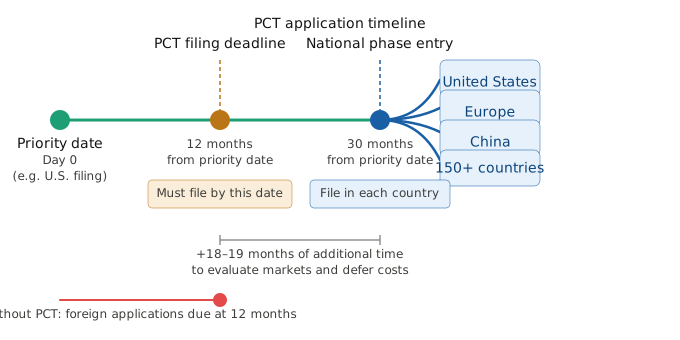
Here is how the timeline works in practice:
- Day 0 — Priority date: You file a patent application (typically a U.S. provisional or nonprovisional application). This establishes your priority date.
- 12 months — PCT filing deadline: You must file the PCT application within 12 months of your earliest priority date. This is a hard deadline — missing it means losing the ability to claim priority to your original filing.
- 30 months — National phase entry: You have until 30 months from your priority date to file patent applications in each individual country or region where you want protection. Some countries allow 31, 34, or even 42 months from the priority date.
Without a PCT application, any foreign patent applications claiming priority to your U.S. filing must be filed within 12 months of your priority date — a deadline that can arrive quickly when you are still evaluating whether your invention has commercial potential. The PCT buys you an additional 18–19 months to make that decision.
A Practical Example
Suppose an inventor files a U.S. provisional patent application on January 1, 2025. That is the priority date.
- By January 1, 2026 (12 months later), the inventor must file the PCT application to preserve foreign filing rights.
- By July 1, 2027 (30 months from the priority date), the inventor must decide which countries to pursue and file national phase applications in each of those countries.
That 18-month window between the PCT filing deadline and the national phase deadline is valuable — it gives the inventor time to assess market reception, secure funding, evaluate licensing opportunities, and make a more informed decision about where to invest in foreign patent protection.
What Does a PCT Application Cost?
The cost of filing a PCT application depends on entity status and which authority conducts the international search. When the USPTO is selected as the International Searching Authority (ISA), the total government fees for a small entity are approximately $2,490 (as of April 2026). This includes the transmittal fee, international filing fee, and search fee.
It is also worth noting that filing a PCT application is generally cost-effective if you plan to pursue patent protection in three or more countries. The filing fees for individual foreign applications — plus translation costs and local attorney fees — add up quickly. The PCT application consolidates the early-stage process and defers those country-specific costs until the national phase.
For a detailed breakdown of U.S. national stage costs, see my U.S. Patent Costs for Foreign Applicants page.
Who Should File a PCT Application?
A PCT application makes the most sense when:
- You want to preserve the option of filing in multiple foreign countries without committing to specific countries right away
- You need more time to evaluate the commercial potential of your invention before spending significant money on foreign filings
- You are seeking funding or licensing deals and want to show investors or licensees that international patent rights are preserved
- You plan to pursue patent protection in three or more countries — making the PCT cost-effective compared to direct foreign filings
A PCT application may not be the right choice if:
- You only need protection in one or two countries — in that case, direct filing may be simpler and less expensive
- You already know exactly which countries you want to file in and are ready to do so now
- Cost is a primary concern and the invention’s commercial potential is uncertain
What Happens During the PCT Process?
After the PCT application is filed, the following steps occur during the international phase:
- International search: The International Searching Authority (typically the USPTO or EPO) conducts a search of prior art and issues an International Search Report and Written Opinion. This gives you an early indication of how the claims are likely to be received during national phase examination.
- International publication: The PCT application is published by WIPO approximately 18 months after the priority date.
- Optional international preliminary examination: You can request an additional examination during the international phase to further evaluate the patentability of your claims before entering the national phase.
- National phase entry: At 30 months from the priority date, you file national phase applications in each country where you want protection, paying the applicable fees and — where required — providing translations.
The PCT and U.S. National Stage Entry
For foreign applicants whose PCT application designates the United States, entering the U.S. national stage involves filing the required documents with the USPTO by the 30-month deadline and paying the applicable fees. I regularly assist foreign patent attorneys and applicants with U.S. national stage entry.
For a detailed guide to the U.S. national stage process, see:
- U.S. National Stage Entry Guide (PCT §371)
- IDS Requirements for U.S. National Stage Entry
- U.S. Patent Costs for Foreign Applicants
Frequently Asked Questions
Does a PCT application give me patent protection in all 150+ countries?
No. A PCT application does not grant any patent rights. It preserves your right to file in PCT member countries and streamlines the process for doing so. You must still file national phase applications in each country where you want protection, pay the applicable fees, and go through examination in each jurisdiction.
Can I file a PCT application after 12 months from my priority date?
No. The PCT application must be filed within 12 months of your earliest priority date. Missing this deadline means losing the ability to claim priority to your original filing for any foreign applications.
What is the difference between a PCT application and a provisional patent application?
A U.S. provisional patent application preserves your U.S. filing date for 12 months. A PCT application preserves your international filing rights and delays foreign filing deadlines by an additional 18–19 months. I sometimes describe the PCT as an “international provisional” — it serves a similar strategic purpose but on a global scale.
Do all countries participate in the PCT system?
Most major countries do — over 150 are PCT members, including the U.S., Canada, Europe, China, Japan, South Korea, Australia, India, and most others where patent protection is commercially important. A small number of countries are not PCT members, and direct filing is required for those jurisdictions.
What happens if I miss the 30-month national phase deadline?
Missing the national phase deadline in a given country generally results in losing the right to obtain a patent in that country based on the PCT application. Some countries allow late entry under certain conditions, but this is not guaranteed and should not be relied upon.
Have Questions About PCT or International Patent Filing?
I help inventors and businesses evaluate whether a PCT application makes sense for their situation, and I handle the filing and prosecution of both U.S. and international patent applications.
Contact me to discuss your patent strategy or get started with a PCT filing.