
What is a Provisional Patent Application?
A provisional patent application secures your filing date for 12 months at a lower cost — giving you time to evaluate your invention before committing to a full patent application.
A provisional patent application is a U.S. patent application that establishes a priority date for an invention without starting the formal examination process. It is not examined by the USPTO, it never becomes a patent on its own, and it will never become public information unless a nonprovisional patent application is filed that claims priority to it.
Think of a provisional patent application as a placeholder — it secures your place in line at the USPTO while you decide whether and how to proceed with full patent protection.
I help inventors and businesses file provisional patent applications as part of a broader patent strategy. If you are considering filing a provisional, contact me to discuss whether it makes sense for your situation.
Oppenhuizen Law PLC
625 Kenmoor Ave. SE, Ste. 301
Grand Rapids, MI 49546
United States
616-242-9550
What Does a Provisional Patent Application Do?
A provisional patent application does two important things:
1. Establishes your priority date
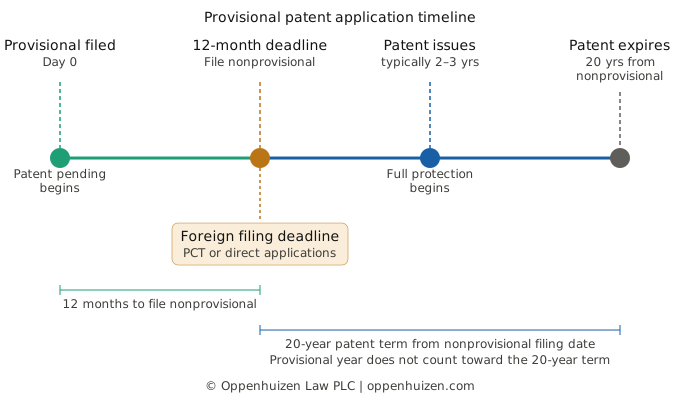
The filing date of your provisional patent application becomes your priority date. This is the date that matters for determining what qualifies as prior art against your invention. Any patent, publication, public disclosure, or other event occurring after your priority date generally cannot be used as prior art against your invention — as long as you file a nonprovisional application within 12 months.
2. Makes you “patent pending”
As soon as your provisional application is filed, you can legally describe your invention as “patent pending.” This puts the public on notice that a patent application has been filed and that patent protection may be coming.
What are the Benefits of Filing a Provisional Patent Application?
Lower cost to establish a priority date
A provisional patent application is significantly less expensive to prepare and file than a full nonprovisional utility patent application. The USPTO filing fee for a provisional is $65 for micro entities, $130 for small entities, and $325 for large entities (as of April 2026). This makes it an accessible first step for inventors who are not yet ready to commit to the full cost of a nonprovisional application.
12 months to evaluate your invention
After filing a provisional, you have 12 months to decide whether to proceed with a full nonprovisional patent application. This gives you time to test the market, seek funding, find licensing partners, or simply evaluate whether the invention has commercial potential — before committing to the full cost of prosecution.
Protects your right to disclose publicly
Once a provisional application is filed, you can publicly disclose your invention, demonstrate it at trade shows, discuss it with potential investors, or begin selling it — without forfeiting your patent rights. Any disclosure after the filing date is protected. This is particularly valuable for inventors who need to show their invention to others before a full patent application is ready.
12-month priority claim for foreign filings
A provisional patent application also starts the 12-month clock for filing foreign patent applications claiming priority to the U.S. filing. If you plan to pursue international patent protection, filing a provisional gives you 12 months to file a PCT application or direct foreign applications claiming priority to your U.S. provisional.
An extra year of patent term — at no cost to your 20-year clock
U.S. utility patents have a term of 20 years measured from the filing date of the nonprovisional application — not from the provisional. This means the 12 months of patent pending status provided by the provisional do not count against your 20-year patent term. Effectively, filing a provisional gives you an additional year of commercial exclusivity compared to filing a nonprovisional directly — the patent pending period buys market time without shortening the patent’s enforceable life.
The Provisional as the Foundation for Your Utility Patent
Think of the provisional patent application as the foundation upon which your utility patent is built. A weak foundation produces a weak patent.
While the formal requirements for a provisional patent application are minimal — no claims are required, and the USPTO does not examine it — the quality of the provisional has a direct and significant impact on the strength of the utility patent that follows.
Here is why: the utility patent application’s claims can only benefit from the provisional’s earlier filing date if the subject matter being claimed was fully and adequately described in the provisional. If your provisional fails to describe an important aspect of the invention, the claims covering that aspect will not get the benefit of the provisional’s filing date — and anything disclosed publicly in the interim could become prior art against those claims.
In my 20+ years of patent practice, I have reviewed a large number of inventor-drafted provisional patent applications. Only a small handful were drafted well enough to provide a solid foundation for a strong utility patent. The most common problems I see in inventor-drafted provisionals include:
- Failure to describe all embodiments and variations of the invention
- Insufficient detail to enable a person skilled in the field to make and use the invention
- Omission of key functional or structural elements that end up being important to the claims
- Focus on the preferred embodiment while ignoring broader implementations
- No drawings, or drawings that do not adequately illustrate the invention
While it is tempting to draft and file a provisional yourself — and while it is legally permissible to do so — the risk is that the provisional you file may not provide the protection you think it does. A professionally drafted provisional is an investment that pays dividends throughout the life of the patent.
What are the Limitations of a Provisional Patent Application?
- It expires after 12 months. A provisional patent application automatically expires 12 months after its filing date. It cannot be extended. If a nonprovisional application is not filed within 12 months, the provisional expires and the priority date is lost.
- It is never examined. A provisional application is not reviewed for patentability by the USPTO. Filing a provisional does not mean a patent will be granted — it only secures the filing date.
- It never becomes a patent on its own. A provisional application cannot mature into a patent. You must file a nonprovisional application within 12 months to keep the process moving toward a granted patent.
- The disclosure must support the later claims. The nonprovisional application’s claims can only claim priority to the provisional’s filing date if the provisional adequately describes the invention. A poorly drafted provisional may not provide the priority date benefit you expect.
What Should a Provisional Patent Application Include?
A provisional patent application should include a detailed written description of the invention — sufficient to enable a person skilled in the relevant field to make and use the invention. Drawings are strongly recommended wherever they help explain the invention.
While a provisional does not require formal patent claims, it is important that the description be thorough. The nonprovisional application’s claims can only benefit from the provisional’s filing date if the subject matter being claimed was adequately described in the provisional. A thin or rushed provisional can undermine the priority date benefit it was intended to provide.
Provisional vs. Nonprovisional Patent Application
| Provisional | Nonprovisional | |
|---|---|---|
| Examined by USPTO? | No | Yes |
| Can become a patent? | No | Yes |
| Filing fee (small entity) | $130 | $730+ |
| Requires formal claims? | No | Yes |
| Establishes priority date? | Yes | Yes |
| Makes you patent pending? | Yes | Yes |
| Counts toward 20-yr term? | No | Yes |
| Duration | 12 months | Until issued or abandoned |
Frequently Asked Questions
Can I file a provisional patent application myself?
Yes — there is no legal requirement to use an attorney to file a provisional patent application. However, a poorly drafted provisional that fails to fully describe the invention may not provide the priority date protection you expect. I recommend working with a patent attorney to ensure the provisional is thorough enough to support the claims you intend to pursue in the nonprovisional.
What happens if I don’t file a nonprovisional within 12 months?
The provisional application expires and the priority date is lost. You cannot revive an expired provisional. If you still want to pursue a patent after the provisional expires, you would need to file a new application — but you would lose the benefit of the original filing date, and any public disclosures you made after the provisional filing date could now be used as prior art against you.
Does a provisional patent application count toward the micro entity application limit?
No. Provisional patent applications do not count toward the four-application limit for micro entity status. Only U.S. nonprovisional utility and design patent applications count toward that limit.
Can I convert a provisional application to a nonprovisional?
Yes. You can file a nonprovisional application that claims priority to your provisional within the 12-month window. Filing a new nonprovisional claiming priority to the provisional is generally the preferred approach.
Is a provisional patent application public?
Not automatically. A provisional application is never published by the USPTO on its own. It only becomes part of the public record if a nonprovisional application is filed that claims priority to it — in which case the provisional is typically published along with the nonprovisional application 18 months after the earliest priority date.
Ready to File a Provisional Patent Application?
A provisional patent application is often the right first step for inventors who want to establish a priority date quickly and affordably while evaluating their next steps. I offer flat fee provisional patent application services.
Contact me to discuss your invention and get started.